
Imagine you're planning a vacation and need to book a place to stay. You visit a website where the interface is clear, easy to use, and you can quickly find the information you need. The booking process is smooth, there are no errors, and you receive an immediate confirmation. This was most likely possible thanks to the UX designer who enhanced the user experience and took all of the user's needs into account to achieve a satisfying process.
So…. What Is UX Design
and What Does a UX Designer Do?
UX Design (User Experience) refers to creating pleasant, meaningful, and above all intuitive experiences for users when they interact with a product or service; this is the result of processes, techniques, and methodologies.
The people responsible for these functions are UX Designers, who manage the interactions users have with the product. They pose a series of questions to answer during the process, looking for intuitive and user-friendly ways to solve a problem without losing sight of the users' needs at each stage of the design.
Differences Between UX Design and UI Design
UX Design (User Experience) and UI Design (User Interface) are two closely related disciplines, but they have key differences.
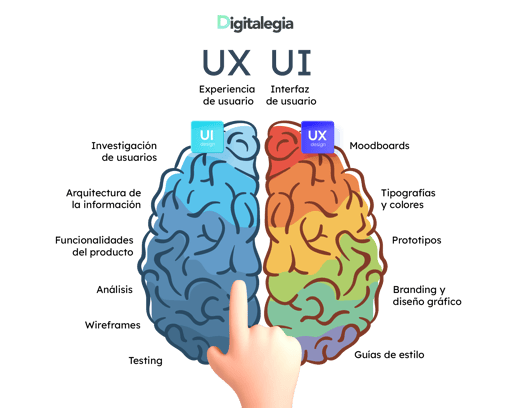
- UX Design: It focuses on the user's overall experience when interacting with a product or service, and centers on how users perceive, interact with, and experience the product; in other words, it handles analysis and optimization, as well as the structure of the product. The goal of UX design is to ensure that the product or service meets the user's needs and expectations, and that the experience is satisfying and useful.
- UI Design: It focuses on the visual and aesthetic side of the product or service, and on how visual elements are organized, through creative, innovative, intuitive, and aesthetically pleasing design. The goal of UI Design is to make the product visually appealing and easy to use, and to make the graphical user interface clear and consistent at every stage of the process.
You may be interested in: UX DESIGN: IN SEARCH OF A BETTER USER EXPERIENCE
UX Design Principles
There are several UX Design principles that can help designers create effective and satisfying products or services. Some of these principles are:
- Usability: Simple, easy to use, and familiar.
- Usefulness: It meets a specific need.
- Desirability: Refers to the visual appearance of the product or service and its ability to evoke positive emotions in users.
- Findability: The ability of the product to provide quick and easy solutions to problems that may arise.
- Accessibility: Accessible to everyone.
- Credibility: The ability of the company, its products, and its services to inspire trust and credibility in users.
UX Design Stages
Below are the typical stages of the UX Design process:
- Research and analysis: Defines the audience profile; here the designer must research and analyze the situation to understand the problem they're trying to solve and identify the users' needs and expectations. In addition, they study the competition and its negative or positive aspects to determine the project's constraints.
- Skeleton: In this step, all the information is laid out, the path to follow is mapped through wireframing, and the essentials are established to work on a minimum viable product (MVP, minimum viable product; as its name suggests, it refers to the basic features of a product or service needed to meet a user's needs). This reveals the paths the user went through, and then a user flow is designed; once the design flow is established, the next step follows.
- Design: Represents the entire creation process (color, shapes, typefaces, buttons, etc.). This step ranges from analysis, functionality, and the resources to be used to the way it will be introduced to the market. In this step, you work hand in hand with a UI Designer, who is in charge of the visual part of the project.

- Testing: This is the most dynamic part of the process. In this step, you verify whether what was proposed is correct or whether changes need to be made. Remember that different methodologies are used, and here Design Thinking lets us go back and make modifications if necessary. Also, keep in mind that a product won't serve forever and will have to be adapted to emerging needs.
- Feedback: When the product or service is ready, feedback is the most important part, since the evolution of your product will depend on it.
In short, UX Design is a user-centered approach that seeks to create meaningful and satisfying experiences through a combination of research, design, usability, and continuous evaluation.
Don't miss a single Digitalegia post and discover how to take your company to the next level.


