

In this video, let's look at an example of how a company has created content for each stage of the Buyer's Journey. This example comes from an agency certified by HubSpot.
The main goal this agency hopes to achieve is for people to buy its website services. But they can't just jump into action and try to make the sale without thinking.
First, they need to have content related to a problem their buyer persona might have. This is where they should provide educational content to help leads educate themselves about the problems they're having as well as the potential opportunities at hand.
In this case, they recognized that their buyer persona has problems with their website conversion rates, so they created a blog post to educate them on the topic.
Now that people understand a bit more about website conversion rates, how they can see improvements and what the benefits of optimizing their website might be, they're ready to start learning a bit more about the details of a solution.
In this case, the solution is redesigning their website. As it happens, this is a service the agency offers, but you'll see that this eBook isn't about the agency itself: it's about "9 Steps to Redesign Your Website."
That's what content does in the consideration stage. It offers educational content to help leads learn more about the solution to their problem or opportunity.
It's not until the decision stage that leads are willing to hear about the actual offers of your services. Think of it this way: "In the awareness stage, they may not have been aware that the website redesign was an opportunity".
In the consideration stage, they probably didn't know whether a redesign was right for them, much less whether they needed one. Only once they're educated about the whole matter will they be ready to hear about the services they can buy.
The decision stage is where you provide content and resources that help your leads learn more and choose the best solution you can offer for their problem.
Now remember that you're still in the planning process. As I mentioned, there are many factors to consider when planning the content process.
To tie all of this together, try using a spreadsheet like this one:
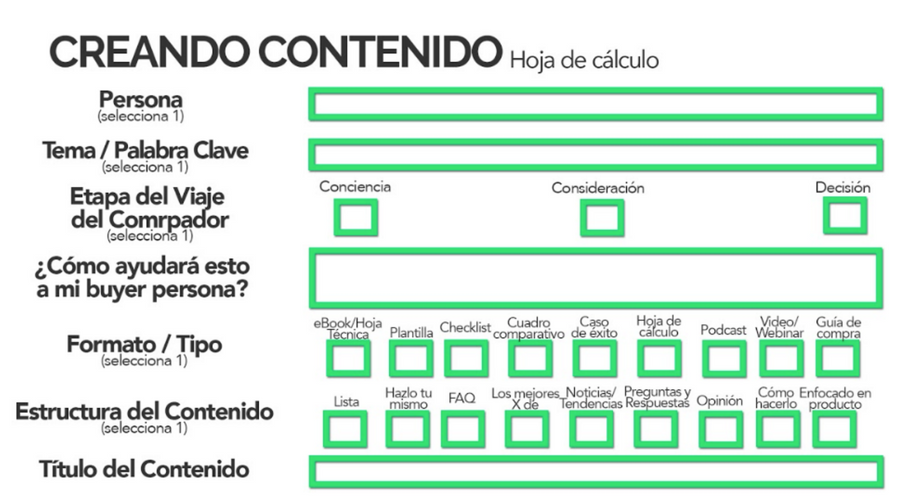
Fill out your spreadsheet so that your piece of content is created for a buyer persona, topic (or keyword), buyer's journey stage, and format and content structure, and start working on a good title for that piece of content.
There's something we skipped, but it was on purpose because it's important: How will this help my buyer persona? Always take a moment to ask yourself this question when you're creating content.
If you can't answer this question, then you may not be planning a valuable piece of content. Remember, you want to create content that helps your buyer persona.
Every time you want to produce a piece of content, start by asking yourself: Who does this help? If the answer is someone other than your buyer persona, go back and think hard about why you're creating content on this topic and in this way.
Let's look at an example of how we can fill out the spreadsheet: Let's imagine that Juan CEO is your buyer persona and something Juan CEO is interested in is website redesign. That will be the topic for this piece of content.
We'll skip the buyer's journey for now. How will this help Juan CEO? Well, Juan CEO needs help understanding what a website redesign involves, how it will benefit him and what kind of commitment the redesign will represent. Because they were able to answer that question and know this will help their buyer persona, they are in the process of creating a piece of valuable content.
In this case, the content will be an eBook and will be structured as a "Do It Yourself" book. Knowing all of this, "9 Steps to Redesign Your Website" will be the starting point for this piece of content.
But what about the buyer's journey? Do you remember which stage of the buyer's journey this fits into? Think for a second... That's right! It's the consideration stage, because it was focused on a solution, not on the problem of improving conversion rates.
Now that you have an idea of what you're going to create, the next step is to actually produce that content, turning those ideas into reality. Your content doesn't have to be long or complicated; you just need to set a plan and follow it.
It all comes down to turning your ideas and plans into real content resources to attract, convert, close and delight. But don't forget: you're not just trying to create content, "you're trying to create valuable content."
There are some best practices you should consider when you start creating a piece of content. And most of them are good news! Especially if you wear several hats in your role.
Focus on Tailoring Content to Your Buyers and Where They Are in the Buyer's Journey
This part is covered in the planning process, but make sure you create a piece of content with a buyer persona and a buyer's journey stage in mind.
"The more specific your content, the better. Yes, broad content can reach a wider audience, but specific content will attract qualified visitors and sales opportunities" - who are more likely to become customers.
Less Is More
Your buyer personas are probably as busy as you are. Make it easy for them to consume your content. This is great news! Don't jump straight into creating a 50-page eBook or a 2-hour Webinar.
Remember, this content is for your buyer personas. Focus more on covering the topic thoroughly than on creating lengthy content. Your buyer personas will thank you.
Make It Educational, Not Promotional
Remember, it's in the decision stage of the buyer's journey that your product should be mentioned. Your website pages are excellent pieces of content for the decision stage.
It's those content offers and blog posts that should focus on education and on the early part of the buyer's journey.
Focus on the Informational Part of the Content First - Then Focus on Design
Writing interesting content is the priority, above making the content look flashy. Yes, content like infographics depends heavily on design, but without the content, that infographic wouldn't exist.
So keep content creation best practices in mind. Always focus on your buyer persona and the buyer's journey, keep it short, make it educational and make design your last concern.
Now, you may think you've made it and that everything is going great, but we're only at the creation part of the content creation process. So don't miss the next video, where we'll look at the next steps of the content creation process: distribution, analysis and repetition.
I'd also like to remind you that watching our videos will help you successfully pass the HubSpot Inbound certification. If you want to learn more about Inbound Marketing, subscribe to our blog and our YouTube channel!
Don't forget to share this post!
