


In the previous video we saw why social media is so important in our inbound strategy. Now we'll dive deeper into each network. Let's get started.
Let's start with Twitter. If we had to describe Twitter, we would say it is a microblogging tool, or a tool for posting short updates, comments, or thoughts online.
And that requires creativity in order to avoid becoming elevator background music and instead be the song everyone is talking about.
To achieve this, you'll need to make sure you use 140 characters or fewer, with the emphasis on fewer. Twitter limits tweets that include a link to just 117 characters, not including attached photos. So challenge yourself to keep your tweets between 100 and 110 characters and use images to better communicate your message.
These 2 examples use fewer than 140 characters, but they also include a link and an image. The lesson we can take away is that you have to be creative and use images or videos. Also, include a link when appropriate and summarize. So go ahead, put your heart into your tweets.
With 1.8 billion active users, Facebook is the most popular social media platform in the world. This also means that posting content on Facebook is very different.
So say goodbye to 140 characters and welcome 250. Ideally, your posts should be approximately 250 characters long, and you should strive to use roughly 80 words. This will help you showcase your brand's personality a little more and engage a wider audience.
Take a look at these 2 examples. Digitalegia on the left and Fresh on the right. Both use fewer than 250 characters, but they also ask the audience about their content. This encourages audience engagement.
As with Twitter, ideally you should use photos, videos, and links; but on Facebook, you can go further by making it personal. Share company selfies if you like. The important thing is to have fun.
Clearly, there is a time and a place for fun; but when seriousness is required, there is a network for that.
LinkedIn takes the term social network to a whole new level. It is a great site for professionals to connect and a magnificent network for your company to share detailed, thought-provoking long-form content.
Post fewer announcements about your company and share an article about how your industry is evolving. You just need to make sure to do it professionally. This brings us to the next best practice: Share industry-relevant content.
This requires you to think not only about the structure of your posts, but also about the type of content you publish and how you will stay relevant to your audience. This content can address the state of your industry or the trends your buyers should pay attention to.
As a result, this will help you establish leadership and become a trusted source of information, not only for your audience but also for other industry leaders.
The last best practice for social media posting is to post consistently. Doing this across all networks can be a challenge and requires keeping up with many things.
That's why the first thing you should do is create a posting schedule that details the content to be published on the different social networks at a given time. Look at this example:
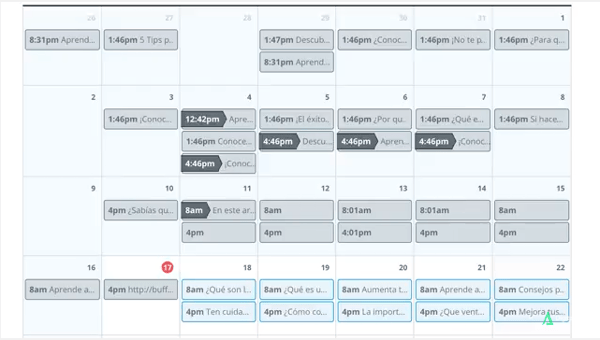
You can see that there is a large number of social media posts that need to go out, sometimes up to six times a day. Creating a social media schedule can be useful for staying organized and keeping your followers engaged.
So, how many times a day should you post on each social media platform? The simple answer is: it depends.
Here are some benchmarks for each channel. If you're just starting to use Twitter, four to six times a day is a good posting frequency. If you want to take advantage of Facebook, it would be best to post at least 2 times a day. LinkedIn and Google+ require less attention, so posting 2 times a week on both networks is an excellent start.
Here's what you need to know: The 5 best practices for posting on social media.
- Remember to optimize your social profile so your prospects can find you, and
- Use a style guide for social media to establish consistency across all platforms.
- Make sure to tailor your content to each network and stand out from the crowd by posting industry-relevant content.
- Finally, post consistently.
We've talked a lot about social media best practices; before we wrap up, let's take a moment for a quick self-check. Fill in the blank.
Social media monitoring is used for all of the following actions except
A. Responding to messages.
B. Segmenting audience members.
C. Publishing new content offers.
D. Staying informed about industry trends.
It's not A, since social media monitoring can be used to respond to messages. Remember the social media keyword sources? When an audience member matches these functions, your job is to craft a personalized response.
Social media monitoring can also be used to segment your audience, so answer B is incorrect. Finally, you should use social media monitoring to stay informed about the industry trends your Buyer Personas might be interested in.
That leaves us with answer C: Social media monitoring is not used to publish new content offers.
In fact, content offers should be distributed through social media posts. So, how did you do? If you had trouble, this would be a good time to review the previous video.
In our next video, we'll look at the best way to analyze your reports and learn how to create good social media reports, so I invite you to subscribe to our blog and YouTube channel!
Don't forget to share this post!