

I'm watching Giada at Home on Hulu. A commercial break comes on, and I see that I can get a low monthly payment of $4,599 a month on a 2021 Nissan Altima, thanks to programmatic marketing.
Programmatic advertising is everywhere, from the podcasts you listen to on your daily commute to the videos you watch on YouTube. These ads also appear as you browse social media sites and even newspapers. In this article, we will go over this comprehensive marketing tool and what these ads look like.
Free Download: Content Creation Template
What Is Programmatic Advertising?
Programmatic ads give brands or companies the ability to buy in milliseconds thanks to a sophisticated ecosystem of algorithms. Ads are bought and sold in real time through the automated system.
 Programmatic Marketing / Programmatic Advertising / Media Buying
Programmatic Marketing is a fancy term for the automated process of buying and selling ads online. This method gives advertisers the ability to place their ads on websites with little human interaction, thanks to algorithms powered by AI (Artificial Intelligence).
Algorithms collect data from online users to choose the ads that fit their tastes and needs. Giada at Home is a family TV show. Families buy cars that are affordable and practical, like the Nissan Altima, so this mid-roll ad works.
What is a mid-roll ad? Don't worry, we'll get to that.
Let's look at what programmatic advertising would look like in a real-life marketing scenario.
An advertiser at a software company wants to sell more software units to technology companies, so they use a programmatic advertising platform that can give them data about online consumers.
The data included could be:
- Demographics (men, women, others, ages 25-45)
- Device (desktop computers, laptops, mobile)
- Interests (stocks, coding, UX design, app optimization)
- Behaviors (monitors content about software development every business day)
After collecting the data, the platform would use the data gathered in real time to select the online audiences that would benefit most from these software ads. It then buys digital ad inventory at auction in the places where the audience would want to see the software ads.
This way, the impact of the ads is optimized through the program. All of this is also analyzed by the platform.
Benefits of Programmatic Marketing
One of the biggest benefits is that programmatic marketing helps all the parties involved make data-driven decisions and, therefore, achieves guaranteed results and ad revenue.
This means it is budget-friendly. You will only spend money on what you know will be effective, based on the software's algorithms. It is a more efficient way to work with ads.
The fact that you can measure the success of campaigns in real time means your campaign management is consolidated and streamlined. Success is in one place, with no going back and forth.
Another big advantage? Your audience will be found for you. Your targets will be reached every time you use a platform like this, and you can also tailor the devices on which it is best to advertise. For example, a desktop ad may not have the same effect if the ad is better optimized for a mobile device, and programmatic platforms will make that decision for you.
All of these benefits are pretty amazing, right? If you are on board with programmatic advertising, let's go over the different types.
Types of Programmatic Advertising
When you get started with programmatic advertising, you have options available to make sure the ad is the best optimized for your campaign. The types we will go over are display, video, social, audio, and native.
Display Ads
These ads appear on web pages. They can appear in the header, the footer, or the sidebar. The way it works is that advertisers work together with different display networks. Some examples are Google, Snapchat, and Microsoft.
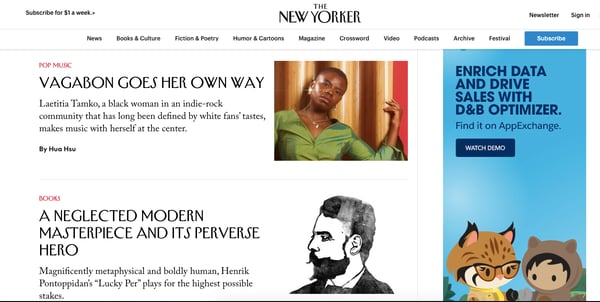
This ad in the sidebar of The New Yorker's web page is for AppExchange, a sales optimization tool. The programmatic ad software may have identified that a large part of The New Yorker's audience on business days between 9 am and 5 pm is interested in that type of software.
Display ads make it easier to buy and sell ad space, and the money earned comes from the click and impression data collected by the ad network.
Video Ads
Video ads are super versatile, and they are also how I got the Nissan ad while watching Hulu. In that situation, Hulu was the publisher and Nissan the advertiser. Video ads can be shown within the stream (in-stream), before the stream (pre-roll), in the middle of the stream (mid-roll), after the stream (post-roll), outside the stream (out-stream), and in on-screen ads (in-display).
In-display ads appear as recommended ads on video-sharing sites like YouTube. They are also clearly labeled as ads in the recommended sections.
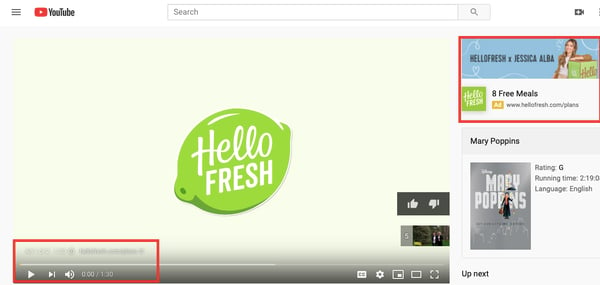
This YouTube web page has an ad in the sidebar, as well as what is known as a pre-roll ad. Pre-roll ads are the ones you see before a video starts, while mid-roll ads appear in the middle of the stream, like a TV commercial.
In-stream ads are shown within a video, like when a YouTube influencer acknowledges the sponsor of their video. Post-roll ads play after the video ends, but out-stream ads are a little different. They are shown on web pages, between articles and videos.
Social Media Ads
Social media ads work through the data the ads themselves need in order to create experiences tailored to the user. The data collected will decide who sees the ads, the formats, and the times to show them.
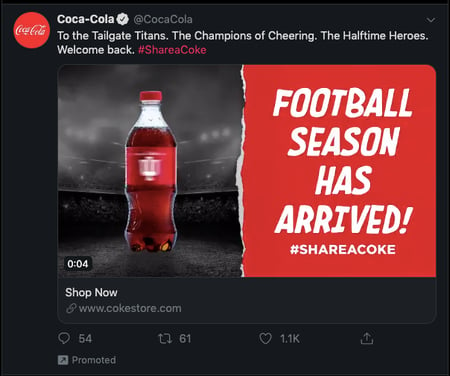
Look at this Coca-Cola ad on my Twitter timeline. I don't like soda that much, but I really do like football. The programmatic ad software probably chose this ad because of my internet history around football.
When social media ads are made by influencers, the process is identical. Influencer programmatic marketing identifies them, contacts them, and automates the campaign from there.
Audio Ads
Have you ever listened to a podcast? If so, how many ads have you heard? That is thanks to programmatic audio advertising.
My favorite platforms, Apple Podcasts, Anchor, and Juum, tend to choose ads focused on business growth and digital marketing, like the Marketing Hack Show. Spotify is also an audio ad channel, especially when people use its Freemium version.
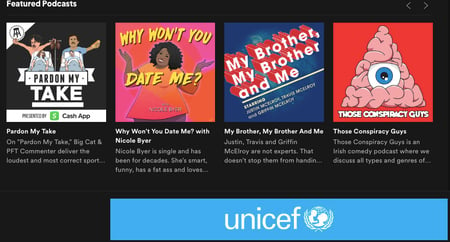
Although you can't hear this Unicef ad, it is a good example of a native ad on the Spotify Podcast web page.
And... what is a native ad, you ask?
Native Ads
Native ads differ from display ads. While display ads are limited to three places, native ads can appear literally anywhere else. This is very useful when you want an ad placed in the middle of a web page, for example.

This is a native ad from The New Yorker that was shown about ¾ of the way down my web page. Native ads are a good idea if you want to capture the reader's attention more directly than a regular display ad.
What do you think? Do you think programmatic marketing is for you? It is a great automated tool for maximizing ad spend and seeing results in real time. You can also see these ads at work if you visit any of your favorite websites right now.
As a marketer, you want to maximize sales through your campaigns as much as possible, and programmatic advertising can be a big advantage with that. I may not be thinking about buying a new car while watching Giada at Home, but some people are, and that is the benefit.

Don't forget to share this post!


