
BUYING CYCLE
Everyone knows that increasing sales volume is one of the most coveted goals for any company. For this reason, it is really important that SEO actions (that is, optimizing the ranking of web pages in online search engines) also appear in the buying cycle of a given product or service.
Now, what does this concept involve? In a nutshell, the buying cycle could be defined as the process a user goes through from the moment they realize they have a need until they purchase one of the company's products, with which they will try to solve what concerns them.
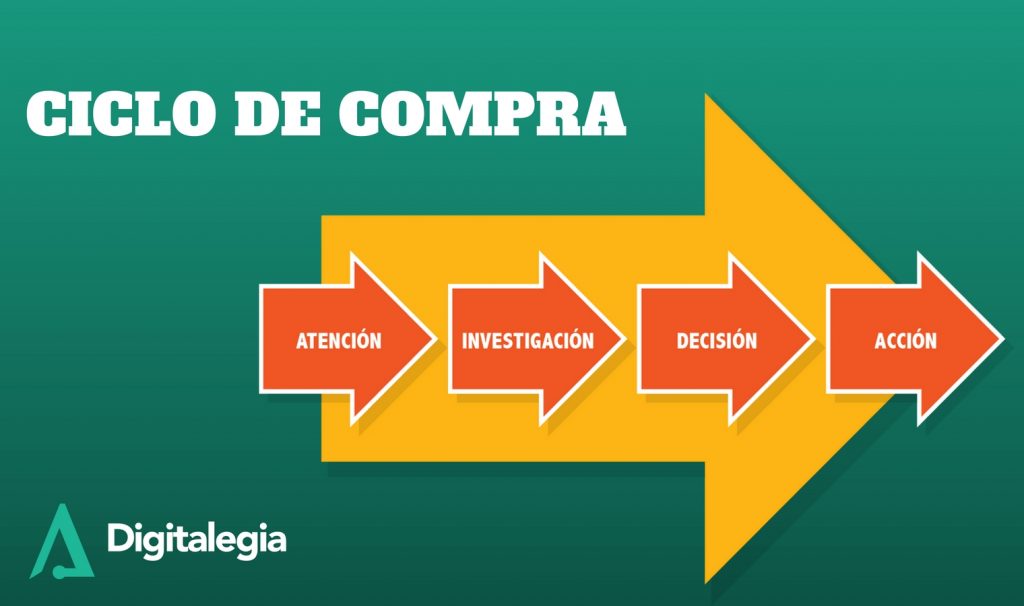
The buying cycle consists of four phases, summed up by the acronym AIDA. Let's look at what each one involves:
- Attention: At this point, the person realizes they have a problem or a need, so they turn to the internet in an attempt to find answers. This user may (or may not) be close to making a purchase. Therefore, depending on their situation, they will look for possible solutions in one way or another. Because of this, it is important for your company to understand their concerns or pain points well, in order to offer them content that matches their expectations. Once this content is created and published, SEO techniques help rank it at the top of internet search results, so that it gains greater visibility and attracts more visits to your company's website. Therefore, SEO helps users find pages with useful content that offer solutions to their problems. As a result, properly optimizing your website can translate into numerous business opportunities. In summary, then, the attention phase is the one in which the company has to go out and find its potential customers, designing a marketing plan for this purpose (through websites, landing pages, etc.) that offers answers to users' problems.
- Interest: This is the moment when users' interest in a given website has to be sparked. Here, not only content comes into play, but also other aspects: for example, the page structure or its navigation paths. These elements must be geared toward one goal: making the visitor not want to leave the page. To achieve this, it is common to turn to a blog that answers their questions. This tool not only generates a large volume of content, but also helps build links that will improve the website's ranking in the results offered by the major search engines.
- Decision: In this phase, the user already has decision criteria and compares several offers that can help solve their problem. They will usually visit various websites with the goal of gathering information that allows them to better meet their needs. That is why it is important for your website to be well designed, to clearly explain the added value of the company and its products or services. Without a doubt, this can encourage users to visit your page instead of choosing your competitors.
- Action: Finally, at this last step of the process, the user makes a decision and gets ready to close the buying cycle. Each possible decision should correspond to a landing page prepared and optimized to close the AIDA process, either through a sale or by filling out a form (which will allow the company to obtain the user's contact details).
The Importance of Understanding the Buying Cycle
It is vitally important that, before launching a marketing campaign or designing a website, the company becomes familiar with the entire AIDA process of each type of potential customer, since every site must be created with them and their needs in mind. In fact, both SEO and content marketing have to be closely tied to the buying cycle, since the company has to be visible to potential customers from the moment they turn to Google to find a solution to their problems.
Likewise, it is not enough to offer them those solutions: you also have to deliver them the way they are looking for them (that is, in the format the potential customer wants). At the same time, you also need a strong online presence and need to contact users several times through different channels (for example, through social media, email, or phone).
Of course, it is worth keeping in mind that not everyone is looking for the same thing, nor do they search in the same way: it all depends on individual interests and on the stage of the buying process each user is in. That is why it is highly advisable to adapt the keywords used in the SEO strategy to each phase of the buying cycle.
In all of them, however, two types of words must be combined:
- Informational: They account for a higher volume of internet searches and can also lead the user to a wide variety of websites. Obviously, these are very commonly used terms, so the price the company must pay to use them is very high. That is why you should try to opt for so-called long tail keywords, which are longer and more specific keyword sequences, as explained in the next paragraph.
- Commercial (long tail keywords): They refer to products and include phrases such as “buy” or “where to buy.” These types of terms clearly indicate that the user is looking for a specific product. From an SEO standpoint, they are the most important, since they are the most profitable, because they are the ones that generate the most sales conversions (keep in mind that they are closer to the end of the buying process). However, they also drive a much smaller number of searches than the previous ones and are used less by users.
In summary, remember that keywords must cover every phase of the buying cycle, from the moment the potential customer gathers information online to the moment they make the payment. Only then is it possible to ensure the success of any marketing or SEO strategy.
We hope these tips have been very helpful. Don't forget to leave us your comments and questions in the box below this post.
If you want to learn more about Inbound marketing, don't forget to subscribe to our blog, or subscribe to our YouTube channel!
