


Let's briefly recap what we saw in the previous video.
We already know that the:
INBOUND BEST PRACTICES
consist of:
- Using BUYER PERSONAS - If you haven't seen the previous video, click here and you will learn what they are and how they should be created.
- Using the BUYER’S JOURNEY.
- Creating VALUABLE CONTENT.
- Knowing how to LEVERAGE IT
We left off saying that to create a good Inbound strategy, it is not enough to just know who we are trying to reach; you also need to know what they are trying to see.
This brings us to the BUYER’S JOURNEY, OR PURCHASE JOURNEY. Every interaction your persona has with your company should be mapped to the stage of the buyer’s journey they are in.
BUYER'S JOURNEY
The PURCHASE JOURNEY, or BUYER’S JOURNEY, is the active research process a person goes through with the purpose of making a purchase.
Knowing the buyer’s journey for your Persona will be the key to creating the best possible content.
Instead of talking about the top, middle or bottom of the funnel, the buyer’s journey is made up of 3 stages: the Awareness, Consideration and Decision stages, which together portray the experiences your potential customers go through.
Each of you has gone through the buyer’s journey. It is the path you take when you have to solve a problem, from researching your potential solutions to purchasing one of them.
The AWARENESS stage happens when your prospect is experiencing and expressing symptoms of a problem. They are doing research and educating themselves to better understand their problem and give it a name.
The CONSIDERATION stage happens when your prospect has identified and named their problem. It is when they set out to research and understand all the possible methods or ways in which they can solve their problem.
The DECISION stage happens when your prospect has decided to carry out a strategy to solve their problem.
They compile a long list of possible vendors and products to put the solution in place. They may also be doing research to narrow down that list and make a final purchase decision.
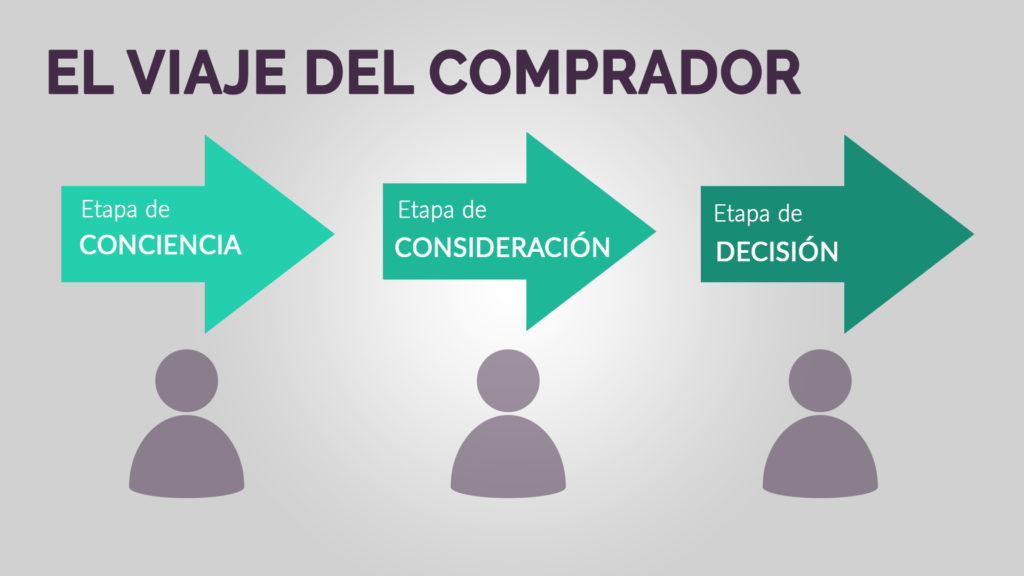
Here is an example of the Buyer’s Journey. Have you ever been sick? Yes, I'm sure you have. Do you remember that feeling of being sick, but not being sure what you might have?
In the Awareness stage, you are experiencing symptoms or having a problem. In this case, your throat feels sore, you have a fever and everything hurts. You ask yourself, “What do I have?”
In the Consideration stage, you realize what your problem is, give it a name and need to see what options you have. You realize - Aha! I have a throat infection, but... what options do I have to relieve and cure my symptoms?
That is when the Decision stage comes in; it is when you decide to solve your problem. If you have a throat infection, you could first go see a doctor, go to a hospital Emergency Room, or just ask the person at the pharmacy counter. You may decide that the Emergency Room is very expensive, but since you are insured, you choose that option.
That is how someone can go through the buyer’s journey. It means looking at it from the buyer’s perspective.
But now imagine yourself as the marketer, or in this case, the doctor. The Doctor normally listens to your symptoms, gives you the options you have to get better, and prescribes a solution. But what would happen if you went to the doctor's office and they did not pay attention to your symptoms and just gave you medicine right away? I don't think you would be left with a very good impression, right?
This is what can often happen with a website's content. Instead of creating content that helps your Buyer Personas come up with potential solutions to their problems, we want to quickly explain our products or services and tell them why they are the best option.
First-time visitors to your website can be in any of the different stages of the buyer’s journey, but you need to have content ready for each and every one of the stages.
How do you feel about the buyer’s journey? Good? Let's test how much you know; the buyer’s journey is very important when it comes to Inbound.
If you were to create a blog post about your product or service, which stage of the Buyer’s Journey would it fit best?
- Awareness stage.
- Consideration stage.
- Decision stage.
Take 5 seconds to think about it.
Your product or service will, in the vast majority of cases, help solve your Persona's problem, but that does not put this post in the Awareness stage.
Your product or service will be one of the solutions, but in this case, your blog post is about you. That is why this piece of content would fit best in the Decision stage.
But here's the thing - Blog posts are not really meant for the Decision Stage.
Trick question, right?
When you are creating content, a blog post to be specific, keep it educational.
Don't educate them on who you are and what you do; educate them on the problems they have and the solutions to those problems. That is the Inbound way of doing things, and it is a way to build trust.
Once you have understood your Buyer Personas and the Buyer’s Journey, it's time to start doing Inbound Marketing. And Inbound Marketing cannot exist without content, which is why CREATING VALUABLE CONTENT is the third of the Inbound Best Practices.
And that is what we will talk about in our next video.
Remember to subscribe to our YouTube channel and our blog. Do you want to be the first to know when Digitalegia publishes new content? Subscribe to our blog!
Don't forget to share this post!

