


The benefits of aligning marketing and sales teams are clear, and best practices are a helpful guide, but without a strategy to integrate smarketing into your company, they would just be data that exists.
In the previous video, we saw how to achieve smarketing alignment.
Today we'll look at how to integrate smarketing. Let's start with the 5 steps to integrate smarketing.
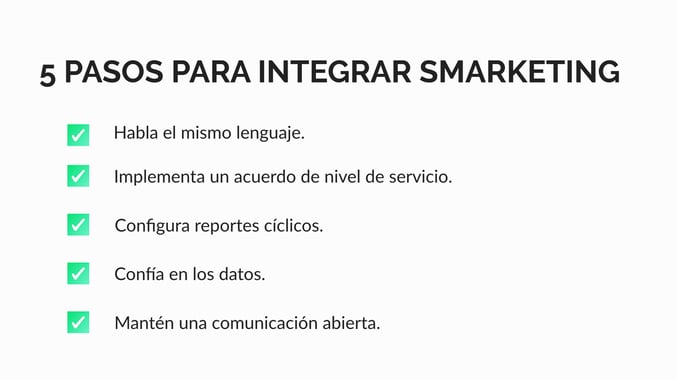
1. Speak the Same Language
Speaking with the same words and speaking the same language are two very different things. You might be surprised how quickly people misunderstand what you're saying if you aren't speaking the same language.
To lay a solid foundation for a shared language, you need to use the marketing and sales funnel, since it is usually well understood by both teams.
The funnel is usually divided into three sections.
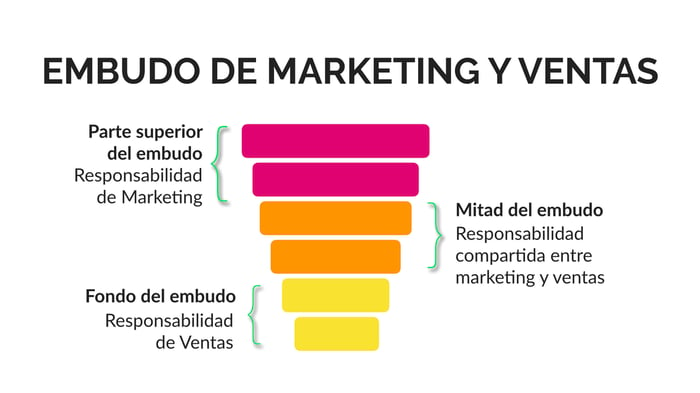
Marketing is responsible for the top of the funnel, and sales is responsible for the bottom of the funnel.
Responsibility for the middle of the funnel is usually shared by both teams, which is why speaking the same language is so important.
Within each of the three sections of the funnel, there are more specific lifecycle stages that need to be defined.
While it may be inevitable to change these definitions to meet the company's needs, both marketing and sales must agree on them.
To make sure we're speaking the same language for the rest of the class, let's look at some basic definitions of each stage:
The most generic term for everyone in a marketing and sales funnel is the contact.
Contact: The term contact doesn't indicate which section of the funnel a person is in; it only indicates that they exist in the funnel.
Prospects are the visitors to your website for whom you've collected a minimum amount of information about them or their behavior on your website, and whether they've subscribed to your newsletter.
When you use the term “lead,” you're referring to a contact who has filled out their information on a form in exchange for a valuable offer, such as an ebook, white paper, presentation, etc. Remember, it's important for your company to define, agree on, and commit to using these definitions.
In the middle of the funnel, you have Marketing Qualified Leads and Sales Qualified Leads.
Marketing Qualified Leads, commonly known as MQLs, are contacts who have raised their hand (metaphorically speaking), identified themselves as a bit more interested, and are ready for sales.
Ideally, you qualify them through certain forms or certain form fields, such as company size, for example. That will move your contact forward in the lifecycle and turn them into an MQL.
Offers such as demo requests, buying guides, and other high-interest offers are usually classified as MQLs.
Once your lead has moved forward and been classified as an MQL, it's time to hand it off to sales so they can review it from top to bottom.
Sales Qualified Leads, or SQLs, are MQLs that the sales team has determined are worth following up on after that analysis. Using this stage helps the teams stay on the same page in terms of the quality and volume of MQLs that marketing is delivering.
The last two stages are known as BOFU, or the bottom of the funnel.
Once sales has marked an MQL as an SQL, their goal is to turn that contact into an opportunity.
An Opportunity is an SQL whom the sales rep has communicated with and classified as a potential customer.
The final step is to close the marketing and sales opportunity as a customer.
See also >>> Inbound Marketing Mini Glossary <<<
Now that you've defined each stage of the funnel, let's take a moment to talk about the framework you can use in your organization to identify MQLs so the sales department can focus on them.
To identify an MQL, you need to have enough information about the contact to evaluate how well they fit your product or service, as well as their level of interest.
The point is to avoid handing contacts off to sales if they aren't a good fit or aren't interested. That can only be described as a waste of time.
Now, if the lead is a great fit for your product or service but still isn't showing much interest, marketing should wait and nurture that lead until it shows interest. For example, this can be achieved through a series of emails with targeted content.
Now, some may decide to hand off that lead anyway, and that's fine. Just make sure sales is aware of it and that their goal is then to stimulate that interest instead of trying to close the deal immediately.
And what happens if they aren't a good fit for your product or service but show a great deal of interest? Well, you'll have to make a tough decision. Should they be marked as an MQL, or should you hand them off to sales to process the purchase order?
This depends on each company; bringing in a customer who isn't a good fit for our product or service could end up being more costly than simply not getting the customer at all.
Now, if the lead is a great fit for your product or service and also shows a lot of interest, you should mark it as an MQL and make sure sales follows up within no more than 24 hours.
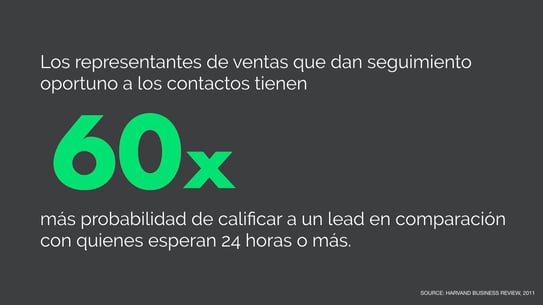
Why 24 hours? Harvard conducted a study of business assessments in which they monitored 1.25 million sales prospects received from 29 B2C companies and 13 B2B companies in the United States.
Sales reps who tried to contact a potential customer within the 1st hour of receiving the contact's information were 7 times more likely to qualify the prospect (which the study defined as having a meaningful conversation with a decision-maker) than those who contacted the prospect after an hour.
And those who waited to contact the prospect until after 24 hours were 60 times less likely to qualify them.
Let's look at some examples of MQLs that the sales team should follow up on within the next 24 hours:
- A contact who downloaded an eBook aimed at generating prospects, whose company has 20,000 employees and is in Latin America.
- A contact at a company in a position that allows them to make decisions, e.g., VP, Director, CEO.
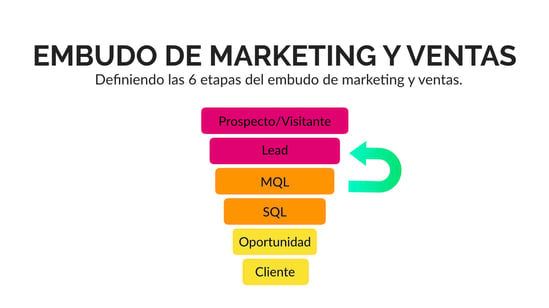
Now, the marketing and sales funnel isn't always linear. For example, imagine the prospect requests a demo, which is why they were qualified as an MQL and handed off to sales. But after sales accepts the lead as an MQL, they realize the lead isn't ready to buy.
In this case, it's better for sales to mark the contact as a lead again, so marketing can continue nurturing their interest.
The key is understanding which contacts belong to marketing so it can keep nurturing them, and which ones belong to sales so it can take them across the finish line.
You want the teams to be in sync so that everyone knows who is responsible for communicating with whom.
2. Implement a Service Level Agreement
Once marketing and sales are speaking the same language, it's time for them to commit to each other. In Smarketing, this is known as a Service Level Agreement, or SLA.
A marketing and sales SLA defines the commitment each team makes regarding the goals to be achieved, so they can support each other and reach the desired revenue.
An SLA is very useful because it crystallizes the teams' alignment around their goals.
It doesn't matter whether you're a one-person team in charge of both teams or a company with 10,000 employees; an SLA formalizes marketing and sales goals to ensure the company is aligned to reach its revenue goal.
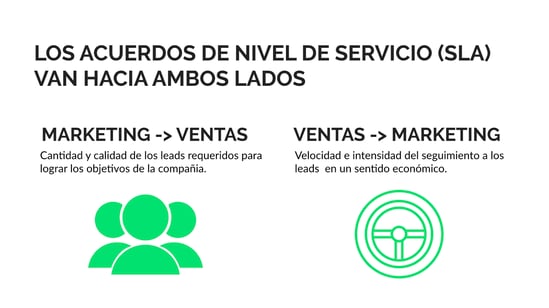
As with everything in smarketing, an SLA goes both ways.
It's a commitment from marketing in terms of the number and quality of MQLs, and it's about what sales commits to marketing in terms of the speed and depth of MQL follow-up.
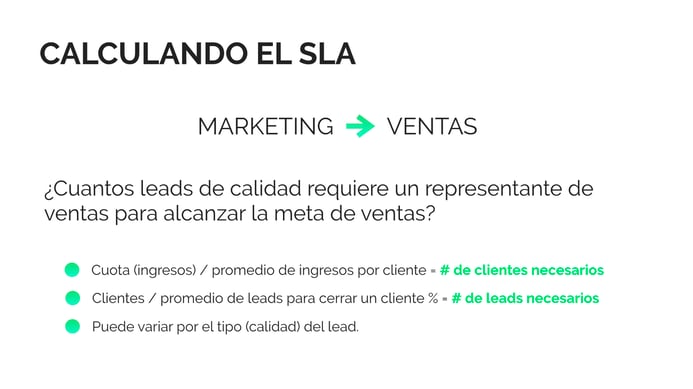
Let's start with the marketing-to-sales SLA. This part is about how many MQLs the marketing team has generated for the sales team so it can reach its sales goals.
The sales-to-marketing SLA requires the entire sales team to commit to a specific number of MQL follow-ups.
Depending on the number of sales reps and their individual quotas, they only have a certain amount of time to commit to calling and emailing MQLs.
You need to know the number of customers you need to have, the number of prospects needed to reach that number of customers, and above all the quality of those prospects. All of this has to do with marketing's prior commitment to sales.
Let's look at an example of how you can determine the numbers needed to create an SLA between marketing and sales.
You can use the following assumptions throughout the example so the math doesn't get complicated:
In this example, the timeline is 1 year, the average ticket amount is historically $1,000, and the conversion rate between each stage of the funnel will be 50%. In other words, 1 out of every two contacts moves on to the next stage.
When we write the SLA, it's best to start with the shared revenue or return goal.
Let's say the revenue goal is $100,000 for this year. Taking into account the historical average ticket amount ($1,000), divide the revenue goal by the average ticket amount to get the number of customers you'll need this year.
In this example, you need 100 new customers to reach the $100,000 goal.
Then take the number of customers you need and multiply it by 2 to find out how many sales opportunities you'll need to get those 100 customers. Here we see that the sales team needs 200 new sales opportunities.
Now let's repeat the process and multiply the number of opportunities by 2 to find out how many SQLs the team needs to work to get that number of opportunities.
Here we see that 400 SQLs are needed.
We'll repeat this process three more times to find out that marketing needs to generate [image 39] 800 MQLs, 1,600 leads, and 3,200 prospects to be part of the team and help sales reach the shared revenue goal.
Now that we know how many contacts need to be reached to achieve our goals, you need to take into account the number of sales reps needed to work those SQLs. Let's use the numbers from the example we just saw to create the sales-to-marketing SLA.
To develop the sales SLA, let's assume the following: There are 48 working weeks in a year. A sales rep has the capacity to review 8 MQLs, call the 4 they've identified as SQLs 2 times, and follow up with them via email three times in a week.
All of sales' additional time goes into working the SQLs they've already contacted and closing the SQLs they've identified as sales opportunities into customers.
Using these assumptions, let's take the 800 MQLs needed in a year and divide them by the 48 working weeks. This gives us approximately 16 MQLs per week.
Based on the assumptions above, to reach the $100,000 goal for the year, you'll need 2 sales reps, each reviewing 8 MQLs per week, identifying and working 4 SQLs, and closing 1 out of 2 sales opportunities into customers.
If you want to keep learning the 5 steps to integrate smarketing, subscribe to our blog at digitalegia.com and to our YouTube channel, and don't forget to turn on the notification bell so you'll know the moment we upload a new video.

Don't forget to share this post!